I am going to try to make this a quick post, as the internet connection this morning has been on and off, pretty much in synch with the rain.
This week has seen a glorious plethora of sporting competitions in the city of Arusha. I am unsure if this week is different from other weeks, or it is just that this week I am actually aware of all (or some) of the events going on. The week started on Saturday, with the opening of the soccer tournament of tour companies. This is an annual event that roughly 10 companies participate in, with the winning team receiving a jackpot of $5,000. It is hosted now, at the end of May because it is the low season, and so most people in the tourism industry don't have any work. This week has been group play - 4 games a day with each team playing a total of 5 games in the group stage. Of course, most teams make this a full day (week) event, and arrive in style waving flags and crowding into safari cars and busses, then staying and cheering on friends, as just about everyone in the safari industries seems to know one another.
I have been enjoying the festive atmosphere, and have often picked up my friend's neices and nephews to watch with them, eating roasted peanuts and ice cream. (The peanuts are decicious, and sometimes if you are lucky they are still hot, while the ice cream looks like it ought to taste like rainbow sorbet, but is most likely frozen sugar water and a very very stale cone).
Saturday morning, I noticed a number of runner looking people running around the track (I believe the track is made of packed dirt with a very light layer of sand/gravel on top). After watching them run a few slow leisurely laps, I was surprised to see them racing! They started to a whistle, and I didn't realize that the 400 was a race until it was almost through. The next event was the 10,000, which wasn't held until close to an hour after the 400. This time I was ready with my stopwatch, and eyes pealed for the start. I could tell by looking at the runners that they were distance runners, but after timing the first lap in 68, I figured perhaps they were running a 3,000, or at most the 5k. But they just kept running! The lead runner (running the second 5k entirely alone) finished in 29.07, which is a great time. I have no idea what his name is, how old he is, or if running is his professional career. With the vast majority of the spectators being soccer fans (the game was going on in the infield throughout the race), there was little interest in the track race going on, although towards the end there was enough interest for cheering through the last lap or two. I was probaby the only person interested in the times, and was even asked at one point if I was a professional scout, since I was writing down lap times (uniformly 69-70 seconds).
As I have been watching the soccer competition for the was week, I have seen these guys running their workouts every morning. yesterday, I saw a guy run a Quentin Cassidy workout - 60 second 400 intervals with a 100meter jogging rest. I wasn't keeping track, but I would guess he ran 20...or more.
All this watching of running has made me really want to run, so I was pleasantly surprised on Tuesday morning when I went for my first "real" run in quite a while that I could run for 35 minutes fairly easily without even feeling sore afterwards. I guess all the walking around gets you more into shape than you realize. It was also kind of fun to have people yelling for the first couple minutes (since I started in town) all kinds of encouragement in Kiswahili and Kimaasai. However, after a few minutes I was very happy to be in the middle of nowhere and on my own.
Thursday, May 28, 2009

Wednesday, May 13, 2009
Tip of the Hat/Wag of the Finger
This post is in honor of the 2 month anniversary of my arrival in East Africa (that either seems really long or really short - I'm not sure which), and in fond memory of evenings spent watching Stephen Colbert at 81 Kilburn Rd. That being said, here is a top -not sure how many yet- good and bad things about my time here:

Education. Definitely not free here, despite the MDGs (Millenium Development Goals) and Tanzanian goverenment commitment to free universal education. Not only is it difficult to attain a primary (let alone secondary) school education, it is virtually impossible if your parents aren't interested in you going to school, which is particularly the case for girls.
Tip of the Hat:
Environment. The commute I have to Arusha is roughly an hour and a half, but I love it. I spend 15-20 minutes walking to the bus stand in Monduli (downhill in the morning, up in the evening), then I wait for a bus - or alternatively I walk until one passes me - then roughly an our on the bus through the vast plains of Meserani and Kisongo until I reach Arusha - with coffee plantations on the outskirts before the busy city center and surrounding buisness areas. Then I walk another 10 minutes to the hospital. I have been making this trip for over 5 weeks now, and have yet to grow tired of it. Some days if I have free time, I even walk the 16km from Monduli to the main east/west road that runs to Arusha.

Tip of the hat to:
Kids. I love kids here. I love spending time with "my" kids - 5 year old Dadi (he discovered last weekend he was 5, not 6 as previously reported) for the most part, who I am now entirely responsible for during the week, and his older brother Billi, who is away at school with his mom during the week. Erika taught Dadi the card game "memory" two weeks ago, and he is still obsessed, although we are working on turning the evening plan to reading short stories in Swahili instead. Also, the new addition of baby Amani. That is the nickname I gave him, and it stuck. He was born Thursday morning at 9am at a whopping 4kgs. Amani is my friend Amme's nephew - his older brother's third child. He is so little, and a week old, is heading home for the first time today from his grandmother's house.
(left: Dadi, right: Billi)
Education. Definitely not free here, despite the MDGs (Millenium Development Goals) and Tanzanian goverenment commitment to free universal education. Not only is it difficult to attain a primary (let alone secondary) school education, it is virtually impossible if your parents aren't interested in you going to school, which is particularly the case for girls.
Tip of the Hat:
Environment. The commute I have to Arusha is roughly an hour and a half, but I love it. I spend 15-20 minutes walking to the bus stand in Monduli (downhill in the morning, up in the evening), then I wait for a bus - or alternatively I walk until one passes me - then roughly an our on the bus through the vast plains of Meserani and Kisongo until I reach Arusha - with coffee plantations on the outskirts before the busy city center and surrounding buisness areas. Then I walk another 10 minutes to the hospital. I have been making this trip for over 5 weeks now, and have yet to grow tired of it. Some days if I have free time, I even walk the 16km from Monduli to the main east/west road that runs to Arusha.
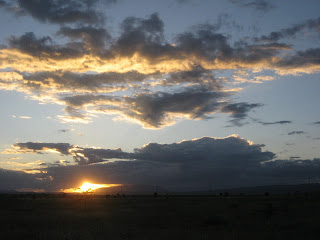
(maybe its just because its the rainy season and there are always clouds, but the sunset is beautiful EVERY night)
Wag of the Finger:
Hygine. I work at a hospital. In the labratory, the technicians who take blood samples use latex gloves. They don't wear them though, they use them to tie around the patients upper arm so that they can find the vein easier. The bathrooms are always disgusting, with stagnant water (and who knows what else) on the ground, and no sinks or running water to wash your hands. At home, I got yelled at for throwing away (giving to the dog) a plate of rice and meat that had been sitting out, uncovered, all night. Apparently my host sister was planning to eat it for breakfast.
Tip of the Hat:
Barack Obama. He is loved here (just like at home). When I tell someone that I am American, it is not uncommon for them to respond, "ahhh... mtu ya Obama!" - or "oh, a person of Obama!" I eagerly tell them that I voted for him, which, always gets a emphatically excited response. There is even a Khanga - fabric worn by women- here with a (fairly unflattering) picture of Obama with the words "Hongera Barack Obama" (Congratulations Barack Obama) and "Upendo na Amani Ametujalia Mungu" (Love and Peace, God has looked after us).Friday, May 8, 2009
St. Elizabeth's
So I write to you today from my desk at St. Elizabeth's Hospital in Arusha. My friend Erika was volunteering here until Monday, and when her time came to leave, everyone asked her who her replacement would be. I eagerly volunteered, as I have been finding little work to do with MOWAT (I actually think there is work to do, just nobody is letting me know what it is). So I am officially here in Arusha working at St. Elizabeth's two days a week (although I think it is likely I will stretch that longer).
Some history (thanks to Erika):
St. Elizabeth Hospital was started as a dispensary in 1975 and due to problems in taking care of mothers and children it was found that there was a need to upgrade this dispensary to a hospital in 1984. This is the second largest hospital in Arusha Municipal, the largest being Mount Meru Government Hospital. It is one amongst the Archdiocesan hospitals, others being Endolen Hospital in Ngorogoro and Waso Hospital in Loliondo District. It acts as a referral hospital to another 14 dispensaries and 3 health centers under the Archdiocese of Arusha. It has 120 staff, a capacity of 100 beds, and treats both inpatients and outpatients. It is the only hospital in Arusha with an ophthalmologist, taking care of eye surgeries and diseases.
So what will I be doing here? My official role is working with the IT team to help get doctors and hospital staff to use the computer network. There are two programs, the first being network system that all hospital staff should be using as an eventual replacement for the paper file system. The second is a very interesting program which allows doctors to post interesting cases to a online site that allows doctors from around the world to comment, or assist in diagnosis. Currently, doctors here are using this fairly infrequently if at all, but it can be a very helpful tool, especially as doctor training here in Tanzania tends to be much less in depth than medical training in countries such as the US.
When not teaching or helping with computer use, I get to help out around the hospital - fitting in whereever needed. During her time here, Erika watched surgeries, helped to give injections and dress wounds, package drugs in the pharmacy, and look at results in the labratory.
Some history (thanks to Erika):
St. Elizabeth Hospital was started as a dispensary in 1975 and due to problems in taking care of mothers and children it was found that there was a need to upgrade this dispensary to a hospital in 1984. This is the second largest hospital in Arusha Municipal, the largest being Mount Meru Government Hospital. It is one amongst the Archdiocesan hospitals, others being Endolen Hospital in Ngorogoro and Waso Hospital in Loliondo District. It acts as a referral hospital to another 14 dispensaries and 3 health centers under the Archdiocese of Arusha. It has 120 staff, a capacity of 100 beds, and treats both inpatients and outpatients. It is the only hospital in Arusha with an ophthalmologist, taking care of eye surgeries and diseases.
So what will I be doing here? My official role is working with the IT team to help get doctors and hospital staff to use the computer network. There are two programs, the first being network system that all hospital staff should be using as an eventual replacement for the paper file system. The second is a very interesting program which allows doctors to post interesting cases to a online site that allows doctors from around the world to comment, or assist in diagnosis. Currently, doctors here are using this fairly infrequently if at all, but it can be a very helpful tool, especially as doctor training here in Tanzania tends to be much less in depth than medical training in countries such as the US.
When not teaching or helping with computer use, I get to help out around the hospital - fitting in whereever needed. During her time here, Erika watched surgeries, helped to give injections and dress wounds, package drugs in the pharmacy, and look at results in the labratory.
Thursday, April 30, 2009
Language
The language that is spoken in Tanzania is Kiswahili, which literally means, language of Swahili. Swahili is originally a mix of languages spoken in coastal East Africa, largely influenced by Arabic, English, and even some German, Portuguese and Hindi. The root of the language both grammatically and in linguistically is bantu, which describes the indiginous African population that moved East from Western Africa hundreds of years ago. Today, Swahili is widely spoken in East Africa - it is the national language of Tanzania, shares the status with English in Kenya, is spoken in parts of northern Malawi, Zambia and Mozambique, and is spoken by large segments of the poplulations of Burundi, Rwanda and Eastern Congo as a result of the wars in those countries that have sent many refugees to Tanzania.
Swahili, like most languages, continues to develop and change. When trying to decipher a text message or understand a common saying, I often find my 6 year old brother more helpful than a dictionary. "Chobisi" is one such word. It is referred to often - "lets meet at chobisi" or "welcome to chobisi," and for the longest time, I would even use the word without fully understanding the meaning. It turns out "Chobisi" is roughly translated to "a place that you go when you don't want to be found." So, a bar that you are hanging out at during your lunch break could be chobisi, or perhaps your favorite place to relax after work. Great word. Wish we had one in English.
Other times, slang is rooted in culture that doesn't make sence. For instance, a slang response to "whats up?" might be "fulu mzuka". Neither fulu or mzuka appear in my dictionary, but I am told mzuka is slang for milk, so fulu mzuka is I am full of milk, or everything is good. To further complicate matters, another response could be "haina maji" or "there is no water." Thus, if you ask whats up, and someone responds, there is no water, what they are saying is there must be milk, therefore, things are good. Follow?
There is also a lot of English that makes its way into Swahili, although often the context isn't quite right. I have a feeling that the majority of English slang arrives through rap music and videos, so often the understanding of what a word means comes from the music or video associated with it. With hip hop music in mind, it becomes easier to understand why a young man or woman might invite you into their home and say "welcome to my ghetto." Some words when they are brought in are pronounced like English, but spelled completely different (usually phonetically), such as the word "afisa," which after saying out loud you might realize means "officer." Other words are spelled as in English, but pronounced completely differently. For instance, in Arusha the public transport are small mini-busses. In Kenya they are called "matatu" (threes) in Dar Es Salaam "dala dala" and here they are reffered to as "ice." After a while, I asked why they are referred to as ice, and was told that it is written on the front of the busses. Ah Ha! Turns out the vast majority of mini-busses in Arusha are of the car brand "hiace," and nobody bothered to tell the people of Arusha that this brand is pronounced "high-ah-chee" so instead it gets pronounced "ice."
One last thing I would like to mention, for the pure fun of it and having nothing to do with language, is that there are a large quantity of 19-0 Perfect season Patriots Championship shirts here. Ahhh.... what could have been.
Swahili, like most languages, continues to develop and change. When trying to decipher a text message or understand a common saying, I often find my 6 year old brother more helpful than a dictionary. "Chobisi" is one such word. It is referred to often - "lets meet at chobisi" or "welcome to chobisi," and for the longest time, I would even use the word without fully understanding the meaning. It turns out "Chobisi" is roughly translated to "a place that you go when you don't want to be found." So, a bar that you are hanging out at during your lunch break could be chobisi, or perhaps your favorite place to relax after work. Great word. Wish we had one in English.
Other times, slang is rooted in culture that doesn't make sence. For instance, a slang response to "whats up?" might be "fulu mzuka". Neither fulu or mzuka appear in my dictionary, but I am told mzuka is slang for milk, so fulu mzuka is I am full of milk, or everything is good. To further complicate matters, another response could be "haina maji" or "there is no water." Thus, if you ask whats up, and someone responds, there is no water, what they are saying is there must be milk, therefore, things are good. Follow?
There is also a lot of English that makes its way into Swahili, although often the context isn't quite right. I have a feeling that the majority of English slang arrives through rap music and videos, so often the understanding of what a word means comes from the music or video associated with it. With hip hop music in mind, it becomes easier to understand why a young man or woman might invite you into their home and say "welcome to my ghetto." Some words when they are brought in are pronounced like English, but spelled completely different (usually phonetically), such as the word "afisa," which after saying out loud you might realize means "officer." Other words are spelled as in English, but pronounced completely differently. For instance, in Arusha the public transport are small mini-busses. In Kenya they are called "matatu" (threes) in Dar Es Salaam "dala dala" and here they are reffered to as "ice." After a while, I asked why they are referred to as ice, and was told that it is written on the front of the busses. Ah Ha! Turns out the vast majority of mini-busses in Arusha are of the car brand "hiace," and nobody bothered to tell the people of Arusha that this brand is pronounced "high-ah-chee" so instead it gets pronounced "ice."
One last thing I would like to mention, for the pure fun of it and having nothing to do with language, is that there are a large quantity of 19-0 Perfect season Patriots Championship shirts here. Ahhh.... what could have been.
Thursday, April 23, 2009
Four Cups of Tea
Before I begin to discuss tea, I want to share some very exciting news: I GOT INTO GRAD SCHOOL!!!! As most of you probably know, for a while I have been thinking about going back to school to get a Masters Degree in Public Health. This winter, I applied, and I got in! Starting in August, I will officially be enrolled in the Masters in International Public Health program at Boston University. I am thrilled, and really excited to be going back to school to study public health. I am also really excited to know what I will be doing when I return to the states!
Now for the tea...
As part of my work with MOWAT, I spent the day yesterday walking around the village of Arkatan which is located in the Monduli district. Rose, The woman I live with is the head teacher at the Arkatan primary school, and the majority of the students there are Maasai. I spent the day walking around visiting different Maasai Bomas and interviewing the women there about development, their needs and access to education. I couldn't help but have flashbacks to the stakeholder interviews we did in Tanzania as part of the study abroad program I did here, only this time my guide and interpreter was helping me to translate into KiMaasai, not English.
Regarding education, I have hit a challenge that I am not exactly sure what to do with. When asking women about the positives and negatives of education girls, the answer seems to be, there really aren't.... in the pastoralist lifestyle, education beyond basic mathmatics so that one knows if they are getting the right change, and basic literacy so that one can read a sign or sign one's name, is virtually meaningless... of course it opens up opportunities for careers and lifestyles outside of traditional Maasai culture, but in terms of tradition, it has so meaning - for girls or for boys. So, while money to help with education fees would be appreciated, throwing money in that direction would likely not make any difference in how many children attend school, and for how long they attend.
So, what's the answer? I don't know. Is there a benefit to girls and boys staying in school in order to learn history and geography, english and science when they plan to spend the rest of their lives herding cattle and goats and carrying firewood and cooking? If there is a benefit, such as having other career options, how do you convince a society to change their views when those decisions are made primarily by the old men?
Now for the tea...
As part of my work with MOWAT, I spent the day yesterday walking around the village of Arkatan which is located in the Monduli district. Rose, The woman I live with is the head teacher at the Arkatan primary school, and the majority of the students there are Maasai. I spent the day walking around visiting different Maasai Bomas and interviewing the women there about development, their needs and access to education. I couldn't help but have flashbacks to the stakeholder interviews we did in Tanzania as part of the study abroad program I did here, only this time my guide and interpreter was helping me to translate into KiMaasai, not English.
Regarding education, I have hit a challenge that I am not exactly sure what to do with. When asking women about the positives and negatives of education girls, the answer seems to be, there really aren't.... in the pastoralist lifestyle, education beyond basic mathmatics so that one knows if they are getting the right change, and basic literacy so that one can read a sign or sign one's name, is virtually meaningless... of course it opens up opportunities for careers and lifestyles outside of traditional Maasai culture, but in terms of tradition, it has so meaning - for girls or for boys. So, while money to help with education fees would be appreciated, throwing money in that direction would likely not make any difference in how many children attend school, and for how long they attend.
So, what's the answer? I don't know. Is there a benefit to girls and boys staying in school in order to learn history and geography, english and science when they plan to spend the rest of their lives herding cattle and goats and carrying firewood and cooking? If there is a benefit, such as having other career options, how do you convince a society to change their views when those decisions are made primarily by the old men?
Wednesday, April 15, 2009
Monduli

Last Tuesday I drove out to Monduli, arriving just after the sun had gone down at a small coffee plantation in the Monduli mountains. As we drove west from Arusha, horizontal lightning periodically brightened the sky to our left, and after 30 minutes or so of driving, we turned off the main road (when we reached Mesarani) and headed north to Monduli. It was just after sunset and the shadow of the Monduli mountains - remnants of past volcanic activity were just visable as a grey outline. After driving 10 or 15 minutes down the smaller road, we began to climb, as as we did, the vast savannah land receded beneath us, giving way to lush vegetation with eucalyptus trees, (and many other trees that I do not know the names of), coffee, bananas and other farms. After a while, we left the tarmac road and drove onto a dirt road, which shortly after we turned off onto a dirt (and muddy) path. That is how I arrived in the small coffee plantation which is my home. It is beautiful. I met Rose, my friend Imma's sister who I will be staying with for the next three months, and Filamina, who is the 18 year old girl who works in the house, and is a riot to spend time with. She loves to gossip, and over the past week we have shared many stories and laughs, in addition to fresh sugar cane.

The organization that Rose has founded is a small NGO called the Monduli Women's Action Trend (MOWAT), and they have very general goals of helping women and children in areas of health, education, development, etc. in the Monduli district of Arusha. After talking at greater length with Rose, it became clear that her main goal is to figure out ways of income generation for women pastoralists. Rose is a teacher, as are the other two women who founded the organization, and one of their biggest frustrations is that many bright students, especially girls, drop out of school after only a few years. Usually the girls want to continue with their education, but they are unable to pay for school fees, or become pregnant. From Rose's experience, the mothers of these girls usually want to help their daughters to go to school, but because in pastoralist (and indeed most Tanzanian) society, the males are in possetion of all the assets, the women are not able to pay for the school fees themselves, and the fathers are usually uninterested in spending their money on the girl's education. So here I am. Over the next few months, I hope to help MOWAT to develop income generating plans to help the women in pastoralist societies - in Monduli this is the Maasai - so that they can pay for their daughters education. This week I have been in town researching ongoing similar projects in Tanzania, and next week I will hopefully be visiting with a number of Maasai communities in Monduli to interview the women to see how we can be of the most service, and how they envision us being able to help.

In the mean time, I am having a wonderful time, I am having a wonderful time getting to know new friends, spending time with old friends (I can give you a price quote for just about any safari now), eating fresh Avocado (our dog Fox LOVES avocados, which conveniently grow on the trees on or farm), getting to know Rose's two sons, Bill (9) and Dadi (6), playing cards, and watching Maisha Plus - the Tanzanian Equivilent of "Survivor." Filamina and I plan to hike up the hills to the top, where there is apparently a crater and you can see elephants. We tried this last Friday, but the rain stopped us after half an hour or so, and we spent the next hour seeking refuge in a neighbor's house, who kindly fed us hot roasted corn as we waited for the rain to stop.
Tuesday, April 7, 2009
April 7
On the night of April 6, 1994, a plane carrying Presidents Juvenal Habyarimana of Rwanda and Cyprien Ntaryarima of Burundi was shot down as it descended into the Kigali airport. The plane was returning from Arusha, Tanzania, where both presidents had been involved in peace talks to end the decades long fighting between Tutsi and Hutu in their respective countries. Within an hour of the plane coming down, roadblocks had been set up in and around Kigali and the massacres had begun.
Today, April 7 is the 15th anniversary of the 100 day long genocide that claimed roughly a million lives. As I look up at the International Rwandan Tribunal now located in Arusha, it is a stark reminder that the atrocities that mostly occured during April, May and June of 1994 could have been largely prevented by the intervention of the international community.
Please take a moment today to educate yourself about what is going out in the world outside of your home. Do not ever think that you are powerless to act. It is your responsibility.
Today, April 7 is the 15th anniversary of the 100 day long genocide that claimed roughly a million lives. As I look up at the International Rwandan Tribunal now located in Arusha, it is a stark reminder that the atrocities that mostly occured during April, May and June of 1994 could have been largely prevented by the intervention of the international community.
Please take a moment today to educate yourself about what is going out in the world outside of your home. Do not ever think that you are powerless to act. It is your responsibility.
Subscribe to:
Posts (Atom)