Did ya miss me?
So here I am, back again, refreshed, excited, and ready to go. I've got new colors, new features, and new adventures! In case you haven't been following along with my internal monologue of plans and such, here is the deal:
I am still a student (although sometimes I pretend I'm way more knowledgeable than that), and am 2/3 the way through with my masters degree in international public health. In order to finish up, I have to do what is called a practicum - or field experience, take a couple more classes, and write a "culminating experience" paper.
Luckily, what my school wants me to do is right in line with what I want me to do, and its really great when that happens! Being obnoxiously overacheiving, I felt that 124 hour requirement for a practicum was pure silliness, and decided that I would look for something a bit longer - like maybe 6 months longer. And so, dear friends and family, I am excited to report that I will be spending June-December of this year working in Lusaka, Zambia with an organization which will remained un-named in the blogosphere, but which I am extremely excited to work with because a)They are are a great organization, b)I believe the work they do is really making a difference in people's lives, and c)I have been very impressed by everyone I have spoken with or met within the organization.
You may now stop and ask yourself, Joni, do you really want to get all your field experience working in an office? I though you were interested in small scale programs as well? And you would be right. So in addition to going to Zambia, I will also be spending the month of May (yes, this May) and a few days of June in Uganda. If you are just catching up on my blog from previous posts, you will remember my friend Erika, who I met in Tanzania, lived in Uganda with her family and visited last spring for the first time since they moved back to the States. so this May, Erika, her mother Sharon, and I will be working with the Ugandan NGO Compassionate Ministries of Uganda (CMU) to host a three week long training-of-trainers in sustainable agriculture and nutrition.
I am nervous, excited, anxious and eagerly awaiting these upcoming projects. There is still plenty to do before I can relax and sit back on the plane, not the least of which includes a 12 page paper on the use of cell phones in tracking falciparum malaria, 2 final exams, packing for 4 seasons (Uganda, Zambia, Winter and Wedding Season), and moving out of my much beloved apartment. However, I have faith that it will all get done, and in 10 days time I will be able to sit back, and look forward to everything which is to come!
Welcome back, and thanks for coming with me on this trip!
Friday, April 30, 2010

Tuesday, August 18, 2009
On Being Home
So I have been back in the states for exactly 2 weeks now. It has not been nearly as shocking as I expected it to be - things here are pretty much how I remember them. I find myself missing friends and loved ones in Tanzania, and things like the gorgeous moutainous background, the seemingly perfect weather (I'm not a fan of this 94 and humid thing), and the night skies filled with uncountable stars that when the moon was full gave off enough light to go outside without any kind of electric light.
There are things about home that are comforting as well. About two weeks before I left Tanzania I made a list of the things I really missed and was looking forward to about being home. There were three things I found the vast majority of my longings revolved around, which were (not necessarily in any particular order), 1. My apartment, and an overall feeling of having control of my life, my schedule and my personal space, 2. My parents house - being able to just drop by whenever I felt like it, and 3. Food. I think that the thing I craved the most often in Tanzania was food, many different kinds of food on many different days. I remember texting hom sometime in May (I think) to ask my mom if craving Strawberry Shortcake was strange. Perhaps whats stranger, is even with all those food cravings, two weeks after arriving home I haven't eaten the vast majority of the foods I found myself craving (including strawberry shortcake), and most often find myself tempted to cook myself dishes I commonly prepared or ate at home in Monduli - hardly a day goes by without me eating kachumbari!
Other than food, the things I missed about being home have been the things I have enjoyed most about being back. I was slightly overwhelmed, but really happy about all the relatives that I got to see (some by dumb luck) in the first week I was home, but the ability to just drop by my parents house for dinner has been priceless. And while I sit here in my apartment with my laptop drinking a cold glass of white wine, I feel really lucky to have a place to live that I love and feel 100% comfortable in.
The good news? Many of the things I missed while I was away are easily remedied. I told Imma when I left that when I come back to Tanzania, he will have to help me find an apartment. I think that I will be a much happier person when I have the ability to just chill out on the weekend in my own space, or if I want to, invite people over to it and throw dinner parties, or buy myself a bottle of wine for the refrigerator. I loved living with Rose and Billy and Dadi, and if I live in Tanzania again, I hope they continue to be parts of my lives, but I am ready to be on my own. The homestays were great, but I no longer feel the need for that aspect of cultural exchange and intimacy. In fact the relationships and friendships I have are more intimate because they are based on mutual friendship and respect, and not just because we live together.
So am I happy to be home? Yes. I am happy to be here, and while there are things that I'm sure I can attribute to "culture shock," I feel for the most part pretty well adjusted. Do I want to go back to Tanzania again? Absolutely. I hope it doesn't take me 41/2 years and getting laid-off from a job this time though. And for the record, when I DO go back to Tanzania, I hope that all of you come and visit me in my beautiful apartment. I promise there will be a bottle of wine in the fridge, and maybe, if you are really lucky, we'll find a way to get some strawberry shortcake too.
Until then, I officially suspend this blog. Thank you all for reading and staying with me all this time. I have pictures to share for those interested in looking, but its certainly not a requirement of friendship. Love to all! Like the baboon says in The Lion King, Asante Sana (squashed banana).
There are things about home that are comforting as well. About two weeks before I left Tanzania I made a list of the things I really missed and was looking forward to about being home. There were three things I found the vast majority of my longings revolved around, which were (not necessarily in any particular order), 1. My apartment, and an overall feeling of having control of my life, my schedule and my personal space, 2. My parents house - being able to just drop by whenever I felt like it, and 3. Food. I think that the thing I craved the most often in Tanzania was food, many different kinds of food on many different days. I remember texting hom sometime in May (I think) to ask my mom if craving Strawberry Shortcake was strange. Perhaps whats stranger, is even with all those food cravings, two weeks after arriving home I haven't eaten the vast majority of the foods I found myself craving (including strawberry shortcake), and most often find myself tempted to cook myself dishes I commonly prepared or ate at home in Monduli - hardly a day goes by without me eating kachumbari!
Other than food, the things I missed about being home have been the things I have enjoyed most about being back. I was slightly overwhelmed, but really happy about all the relatives that I got to see (some by dumb luck) in the first week I was home, but the ability to just drop by my parents house for dinner has been priceless. And while I sit here in my apartment with my laptop drinking a cold glass of white wine, I feel really lucky to have a place to live that I love and feel 100% comfortable in.
The good news? Many of the things I missed while I was away are easily remedied. I told Imma when I left that when I come back to Tanzania, he will have to help me find an apartment. I think that I will be a much happier person when I have the ability to just chill out on the weekend in my own space, or if I want to, invite people over to it and throw dinner parties, or buy myself a bottle of wine for the refrigerator. I loved living with Rose and Billy and Dadi, and if I live in Tanzania again, I hope they continue to be parts of my lives, but I am ready to be on my own. The homestays were great, but I no longer feel the need for that aspect of cultural exchange and intimacy. In fact the relationships and friendships I have are more intimate because they are based on mutual friendship and respect, and not just because we live together.
So am I happy to be home? Yes. I am happy to be here, and while there are things that I'm sure I can attribute to "culture shock," I feel for the most part pretty well adjusted. Do I want to go back to Tanzania again? Absolutely. I hope it doesn't take me 41/2 years and getting laid-off from a job this time though. And for the record, when I DO go back to Tanzania, I hope that all of you come and visit me in my beautiful apartment. I promise there will be a bottle of wine in the fridge, and maybe, if you are really lucky, we'll find a way to get some strawberry shortcake too.
Until then, I officially suspend this blog. Thank you all for reading and staying with me all this time. I have pictures to share for those interested in looking, but its certainly not a requirement of friendship. Love to all! Like the baboon says in The Lion King, Asante Sana (squashed banana).
Friday, July 3, 2009
One man's fortune...
My sources back home tell me that Boston missed by one sunny day the distinguishment of having the rainiest June on record. Now that the weather forcast predicts the spell to be lifting, and sunny days ahead - after tomorrow at least, I will take a moment to lament at how appreciative we in Tanzania would be to get that kind of rain.
The rainy season in Tanzania has ended. The long dry season has been heralded in with the coming of winter - July in Tanzania is cold. Well, not by New England standards, but when you are used to 80 degree days, waking up to 55 degrees is downright chilly. Of course it usually warms up by afternoon, or in my world, sometime after 3-4 cups of hot ginger tea have been drunk. While I can't boast of any records being broken, this past rainy season has been dry by anyone's standards. The effects are painfully obvious.
Crops that were planted over the past few months in expectation of the rain that never came are past wilted to in many cases completely ruined. In Monduli, which typically gets more rain because of its altitude, most corn and potato crops have failed and even plants better suited to dry weather such as banana trees have begun to wilt.

the corn field next to my house
When I come down from the mountain, the crop failure is even more obvious, with field after field of yellow half grown corn, and dry grass as far as I can see. There is a human component to this, both in cause and effect. Many of these crops were planted in land that was previously used for grazing short grasses, and the land was in many cases never suited for crop production. The ever growing population of Tanzania has led to both over grazing of these areas and over cultivation, and a resulting desertification which I have previously discussed. Last year, the rains did not fail, and as a result perhaps there was overconfidence in the amount of farming and grazing the land is able to sustain. However, this year is different.
In Northern Tanzania near Lake Natron (where an astute observer may remember I stayed with a Maasai homestay family in 2004), the government has already begun providing food aid because the price of corn (the only ingrediant aside from water in Tanzania's staple food Ugali) has risen so high.
On the Tanzanian border with Kenya, there are reports of Kenyan Maasai herding their cattle accross the border to Tanzania. On the Northern slopes of Kilimanjaro which offer a small respite, there are reports that over 40,000 head of cattle have crossed the border within the past two weeks.
In the Serengeti, home to one of the worlds largest migrations, migration is not occuring because the 1.2 million wildebeast - the grass eating ruminants that form the base of the migrations - are not migrating. Usually they go north to eat off the grasses of the Maasai Mara plains, but with the grasses dry, they are not moving.
Tanzania (and Kenya) face both a short and long term crisis. In the short term, over the next few months there will likely be water shortages, electric shortages (as much of Tanzania's electricity is water powered), rising food prices as crops continue to fail, hunger, and massive herd mortality. In the long term, there are questions of population, land use, conservation, and food security that will need to be addressed.
Monday, June 22, 2009
Culture Shock, and the Great Migration
I haven't made a blog post for a while, and I sincerely apologize for that fact. I find (similarly to the last time I was here I believe) that the longer I get into living here, the more all I have to tell are short vignettes rather than deep startling and mind changing observations.
Two weekends ago, I took my first trip to Kenya. I was required to go (actually to leave Tanzania) because my entry permit to Tanzania allowed me to stay 90 days. Luckily, the visa itself is good for a full year, and I can come in and out as many times as I want, for a maximum stay of 90 days each time. So I headed out of Arusha a few Fridays ago in a tiny peugot (strait out of the 70's) packed with a driver and 8 passengers for the ride to Namanga - the town at the border crossing with Kenya. I had been told the road was bad, but that didn't prepare me for the literally dirt and rock road we drove on for the next 2 and 1/2 hours, while dust floated in through the non-functional windows and up through the floorboards and trunk of the car. At the border I climbed into the Kenyan version of a dala-dala, the "matatu" which was a less dusty and slightly more spacious relief. Arriving in Nairobi around 7pm, I was blown away by the size of the city. Everything everyone has ever said to me about "Nairobi being different" did not prepare me for how big and European it felt at times, while still retaining aspects of the life I have been used to over the past few months. I loved the break I got - visiting my friend Anna from college and talking about mutual friends, how Richmond Indiana has changed, swimming in the pool at her apartment complex (!!!) a friend's band at an Ethiopian restaurant, going to the movies, drinking real cappuccinos and whole grain bread, a picnic at the top of the KICC, and a fancy Italian dinner. For the past 3 months living in Monduli, I have felt like Arusha is this huge city, and being in Nairobi made me realize why guide books reffer to Arusha as an outpost town for Northern Circut safaris.
Arusha itself has been changing though! For the past few months, my friends and I have been refering to the pattern of foreigners comming to Tanzania during the summer and Christmas Holiday seasons as "the great migration" (The joke being that the only migration larger than that of the serengeti is the one of the Wazungu - white people - who come to watch it). Over the past 2-3 weeks, the migration has returned in massive numbers. The city actually feels really different. Beginning in June, here at the hospital there has been a revolving door of "volunteers" who come for a day, a week, a few weeks and observe rounds, help pre-pack medicine or watch the lab technicians. Some of the work they do really is helpful, but it is clear that the main people benefitting are the volunteers themselves. I find myself more and more trying to avoid town center, as the street hawkers are more persistant, knowing that us wazungu are mostly trying to buy souveniers and trinkets. I find myself struggling to figure out how to interact with other white people. Am I their guide or offer them support when I see them looking lost or unsure? Do I avoid them entirely, or pretend not to notice that they are any different from Tanzanians?
Two weekends ago, I took my first trip to Kenya. I was required to go (actually to leave Tanzania) because my entry permit to Tanzania allowed me to stay 90 days. Luckily, the visa itself is good for a full year, and I can come in and out as many times as I want, for a maximum stay of 90 days each time. So I headed out of Arusha a few Fridays ago in a tiny peugot (strait out of the 70's) packed with a driver and 8 passengers for the ride to Namanga - the town at the border crossing with Kenya. I had been told the road was bad, but that didn't prepare me for the literally dirt and rock road we drove on for the next 2 and 1/2 hours, while dust floated in through the non-functional windows and up through the floorboards and trunk of the car. At the border I climbed into the Kenyan version of a dala-dala, the "matatu" which was a less dusty and slightly more spacious relief. Arriving in Nairobi around 7pm, I was blown away by the size of the city. Everything everyone has ever said to me about "Nairobi being different" did not prepare me for how big and European it felt at times, while still retaining aspects of the life I have been used to over the past few months. I loved the break I got - visiting my friend Anna from college and talking about mutual friends, how Richmond Indiana has changed, swimming in the pool at her apartment complex (!!!) a friend's band at an Ethiopian restaurant, going to the movies, drinking real cappuccinos and whole grain bread, a picnic at the top of the KICC, and a fancy Italian dinner. For the past 3 months living in Monduli, I have felt like Arusha is this huge city, and being in Nairobi made me realize why guide books reffer to Arusha as an outpost town for Northern Circut safaris.
Arusha itself has been changing though! For the past few months, my friends and I have been refering to the pattern of foreigners comming to Tanzania during the summer and Christmas Holiday seasons as "the great migration" (The joke being that the only migration larger than that of the serengeti is the one of the Wazungu - white people - who come to watch it). Over the past 2-3 weeks, the migration has returned in massive numbers. The city actually feels really different. Beginning in June, here at the hospital there has been a revolving door of "volunteers" who come for a day, a week, a few weeks and observe rounds, help pre-pack medicine or watch the lab technicians. Some of the work they do really is helpful, but it is clear that the main people benefitting are the volunteers themselves. I find myself more and more trying to avoid town center, as the street hawkers are more persistant, knowing that us wazungu are mostly trying to buy souveniers and trinkets. I find myself struggling to figure out how to interact with other white people. Am I their guide or offer them support when I see them looking lost or unsure? Do I avoid them entirely, or pretend not to notice that they are any different from Tanzanians?
Thursday, May 28, 2009
Mashindano (Competitions)
I am going to try to make this a quick post, as the internet connection this morning has been on and off, pretty much in synch with the rain.
This week has seen a glorious plethora of sporting competitions in the city of Arusha. I am unsure if this week is different from other weeks, or it is just that this week I am actually aware of all (or some) of the events going on. The week started on Saturday, with the opening of the soccer tournament of tour companies. This is an annual event that roughly 10 companies participate in, with the winning team receiving a jackpot of $5,000. It is hosted now, at the end of May because it is the low season, and so most people in the tourism industry don't have any work. This week has been group play - 4 games a day with each team playing a total of 5 games in the group stage. Of course, most teams make this a full day (week) event, and arrive in style waving flags and crowding into safari cars and busses, then staying and cheering on friends, as just about everyone in the safari industries seems to know one another.
I have been enjoying the festive atmosphere, and have often picked up my friend's neices and nephews to watch with them, eating roasted peanuts and ice cream. (The peanuts are decicious, and sometimes if you are lucky they are still hot, while the ice cream looks like it ought to taste like rainbow sorbet, but is most likely frozen sugar water and a very very stale cone).
Saturday morning, I noticed a number of runner looking people running around the track (I believe the track is made of packed dirt with a very light layer of sand/gravel on top). After watching them run a few slow leisurely laps, I was surprised to see them racing! They started to a whistle, and I didn't realize that the 400 was a race until it was almost through. The next event was the 10,000, which wasn't held until close to an hour after the 400. This time I was ready with my stopwatch, and eyes pealed for the start. I could tell by looking at the runners that they were distance runners, but after timing the first lap in 68, I figured perhaps they were running a 3,000, or at most the 5k. But they just kept running! The lead runner (running the second 5k entirely alone) finished in 29.07, which is a great time. I have no idea what his name is, how old he is, or if running is his professional career. With the vast majority of the spectators being soccer fans (the game was going on in the infield throughout the race), there was little interest in the track race going on, although towards the end there was enough interest for cheering through the last lap or two. I was probaby the only person interested in the times, and was even asked at one point if I was a professional scout, since I was writing down lap times (uniformly 69-70 seconds).
As I have been watching the soccer competition for the was week, I have seen these guys running their workouts every morning. yesterday, I saw a guy run a Quentin Cassidy workout - 60 second 400 intervals with a 100meter jogging rest. I wasn't keeping track, but I would guess he ran 20...or more.
All this watching of running has made me really want to run, so I was pleasantly surprised on Tuesday morning when I went for my first "real" run in quite a while that I could run for 35 minutes fairly easily without even feeling sore afterwards. I guess all the walking around gets you more into shape than you realize. It was also kind of fun to have people yelling for the first couple minutes (since I started in town) all kinds of encouragement in Kiswahili and Kimaasai. However, after a few minutes I was very happy to be in the middle of nowhere and on my own.
This week has seen a glorious plethora of sporting competitions in the city of Arusha. I am unsure if this week is different from other weeks, or it is just that this week I am actually aware of all (or some) of the events going on. The week started on Saturday, with the opening of the soccer tournament of tour companies. This is an annual event that roughly 10 companies participate in, with the winning team receiving a jackpot of $5,000. It is hosted now, at the end of May because it is the low season, and so most people in the tourism industry don't have any work. This week has been group play - 4 games a day with each team playing a total of 5 games in the group stage. Of course, most teams make this a full day (week) event, and arrive in style waving flags and crowding into safari cars and busses, then staying and cheering on friends, as just about everyone in the safari industries seems to know one another.
I have been enjoying the festive atmosphere, and have often picked up my friend's neices and nephews to watch with them, eating roasted peanuts and ice cream. (The peanuts are decicious, and sometimes if you are lucky they are still hot, while the ice cream looks like it ought to taste like rainbow sorbet, but is most likely frozen sugar water and a very very stale cone).
Saturday morning, I noticed a number of runner looking people running around the track (I believe the track is made of packed dirt with a very light layer of sand/gravel on top). After watching them run a few slow leisurely laps, I was surprised to see them racing! They started to a whistle, and I didn't realize that the 400 was a race until it was almost through. The next event was the 10,000, which wasn't held until close to an hour after the 400. This time I was ready with my stopwatch, and eyes pealed for the start. I could tell by looking at the runners that they were distance runners, but after timing the first lap in 68, I figured perhaps they were running a 3,000, or at most the 5k. But they just kept running! The lead runner (running the second 5k entirely alone) finished in 29.07, which is a great time. I have no idea what his name is, how old he is, or if running is his professional career. With the vast majority of the spectators being soccer fans (the game was going on in the infield throughout the race), there was little interest in the track race going on, although towards the end there was enough interest for cheering through the last lap or two. I was probaby the only person interested in the times, and was even asked at one point if I was a professional scout, since I was writing down lap times (uniformly 69-70 seconds).
As I have been watching the soccer competition for the was week, I have seen these guys running their workouts every morning. yesterday, I saw a guy run a Quentin Cassidy workout - 60 second 400 intervals with a 100meter jogging rest. I wasn't keeping track, but I would guess he ran 20...or more.
All this watching of running has made me really want to run, so I was pleasantly surprised on Tuesday morning when I went for my first "real" run in quite a while that I could run for 35 minutes fairly easily without even feeling sore afterwards. I guess all the walking around gets you more into shape than you realize. It was also kind of fun to have people yelling for the first couple minutes (since I started in town) all kinds of encouragement in Kiswahili and Kimaasai. However, after a few minutes I was very happy to be in the middle of nowhere and on my own.
Wednesday, May 13, 2009
Tip of the Hat/Wag of the Finger
This post is in honor of the 2 month anniversary of my arrival in East Africa (that either seems really long or really short - I'm not sure which), and in fond memory of evenings spent watching Stephen Colbert at 81 Kilburn Rd. That being said, here is a top -not sure how many yet- good and bad things about my time here:

Education. Definitely not free here, despite the MDGs (Millenium Development Goals) and Tanzanian goverenment commitment to free universal education. Not only is it difficult to attain a primary (let alone secondary) school education, it is virtually impossible if your parents aren't interested in you going to school, which is particularly the case for girls.
Tip of the Hat:
Environment. The commute I have to Arusha is roughly an hour and a half, but I love it. I spend 15-20 minutes walking to the bus stand in Monduli (downhill in the morning, up in the evening), then I wait for a bus - or alternatively I walk until one passes me - then roughly an our on the bus through the vast plains of Meserani and Kisongo until I reach Arusha - with coffee plantations on the outskirts before the busy city center and surrounding buisness areas. Then I walk another 10 minutes to the hospital. I have been making this trip for over 5 weeks now, and have yet to grow tired of it. Some days if I have free time, I even walk the 16km from Monduli to the main east/west road that runs to Arusha.

Tip of the hat to:
Kids. I love kids here. I love spending time with "my" kids - 5 year old Dadi (he discovered last weekend he was 5, not 6 as previously reported) for the most part, who I am now entirely responsible for during the week, and his older brother Billi, who is away at school with his mom during the week. Erika taught Dadi the card game "memory" two weeks ago, and he is still obsessed, although we are working on turning the evening plan to reading short stories in Swahili instead. Also, the new addition of baby Amani. That is the nickname I gave him, and it stuck. He was born Thursday morning at 9am at a whopping 4kgs. Amani is my friend Amme's nephew - his older brother's third child. He is so little, and a week old, is heading home for the first time today from his grandmother's house.
(left: Dadi, right: Billi)
Education. Definitely not free here, despite the MDGs (Millenium Development Goals) and Tanzanian goverenment commitment to free universal education. Not only is it difficult to attain a primary (let alone secondary) school education, it is virtually impossible if your parents aren't interested in you going to school, which is particularly the case for girls.
Tip of the Hat:
Environment. The commute I have to Arusha is roughly an hour and a half, but I love it. I spend 15-20 minutes walking to the bus stand in Monduli (downhill in the morning, up in the evening), then I wait for a bus - or alternatively I walk until one passes me - then roughly an our on the bus through the vast plains of Meserani and Kisongo until I reach Arusha - with coffee plantations on the outskirts before the busy city center and surrounding buisness areas. Then I walk another 10 minutes to the hospital. I have been making this trip for over 5 weeks now, and have yet to grow tired of it. Some days if I have free time, I even walk the 16km from Monduli to the main east/west road that runs to Arusha.
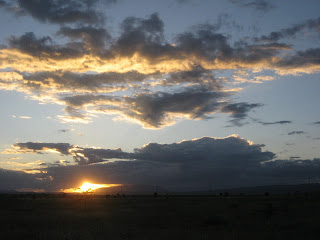
(maybe its just because its the rainy season and there are always clouds, but the sunset is beautiful EVERY night)
Wag of the Finger:
Hygine. I work at a hospital. In the labratory, the technicians who take blood samples use latex gloves. They don't wear them though, they use them to tie around the patients upper arm so that they can find the vein easier. The bathrooms are always disgusting, with stagnant water (and who knows what else) on the ground, and no sinks or running water to wash your hands. At home, I got yelled at for throwing away (giving to the dog) a plate of rice and meat that had been sitting out, uncovered, all night. Apparently my host sister was planning to eat it for breakfast.
Tip of the Hat:
Barack Obama. He is loved here (just like at home). When I tell someone that I am American, it is not uncommon for them to respond, "ahhh... mtu ya Obama!" - or "oh, a person of Obama!" I eagerly tell them that I voted for him, which, always gets a emphatically excited response. There is even a Khanga - fabric worn by women- here with a (fairly unflattering) picture of Obama with the words "Hongera Barack Obama" (Congratulations Barack Obama) and "Upendo na Amani Ametujalia Mungu" (Love and Peace, God has looked after us).Friday, May 8, 2009
St. Elizabeth's
So I write to you today from my desk at St. Elizabeth's Hospital in Arusha. My friend Erika was volunteering here until Monday, and when her time came to leave, everyone asked her who her replacement would be. I eagerly volunteered, as I have been finding little work to do with MOWAT (I actually think there is work to do, just nobody is letting me know what it is). So I am officially here in Arusha working at St. Elizabeth's two days a week (although I think it is likely I will stretch that longer).
Some history (thanks to Erika):
St. Elizabeth Hospital was started as a dispensary in 1975 and due to problems in taking care of mothers and children it was found that there was a need to upgrade this dispensary to a hospital in 1984. This is the second largest hospital in Arusha Municipal, the largest being Mount Meru Government Hospital. It is one amongst the Archdiocesan hospitals, others being Endolen Hospital in Ngorogoro and Waso Hospital in Loliondo District. It acts as a referral hospital to another 14 dispensaries and 3 health centers under the Archdiocese of Arusha. It has 120 staff, a capacity of 100 beds, and treats both inpatients and outpatients. It is the only hospital in Arusha with an ophthalmologist, taking care of eye surgeries and diseases.
So what will I be doing here? My official role is working with the IT team to help get doctors and hospital staff to use the computer network. There are two programs, the first being network system that all hospital staff should be using as an eventual replacement for the paper file system. The second is a very interesting program which allows doctors to post interesting cases to a online site that allows doctors from around the world to comment, or assist in diagnosis. Currently, doctors here are using this fairly infrequently if at all, but it can be a very helpful tool, especially as doctor training here in Tanzania tends to be much less in depth than medical training in countries such as the US.
When not teaching or helping with computer use, I get to help out around the hospital - fitting in whereever needed. During her time here, Erika watched surgeries, helped to give injections and dress wounds, package drugs in the pharmacy, and look at results in the labratory.
Some history (thanks to Erika):
St. Elizabeth Hospital was started as a dispensary in 1975 and due to problems in taking care of mothers and children it was found that there was a need to upgrade this dispensary to a hospital in 1984. This is the second largest hospital in Arusha Municipal, the largest being Mount Meru Government Hospital. It is one amongst the Archdiocesan hospitals, others being Endolen Hospital in Ngorogoro and Waso Hospital in Loliondo District. It acts as a referral hospital to another 14 dispensaries and 3 health centers under the Archdiocese of Arusha. It has 120 staff, a capacity of 100 beds, and treats both inpatients and outpatients. It is the only hospital in Arusha with an ophthalmologist, taking care of eye surgeries and diseases.
So what will I be doing here? My official role is working with the IT team to help get doctors and hospital staff to use the computer network. There are two programs, the first being network system that all hospital staff should be using as an eventual replacement for the paper file system. The second is a very interesting program which allows doctors to post interesting cases to a online site that allows doctors from around the world to comment, or assist in diagnosis. Currently, doctors here are using this fairly infrequently if at all, but it can be a very helpful tool, especially as doctor training here in Tanzania tends to be much less in depth than medical training in countries such as the US.
When not teaching or helping with computer use, I get to help out around the hospital - fitting in whereever needed. During her time here, Erika watched surgeries, helped to give injections and dress wounds, package drugs in the pharmacy, and look at results in the labratory.
Subscribe to:
Posts (Atom)